investing
Investment basics
Intro stock market
terminology
- investment: An investment is an asset bought by an individual or organization with the expectation that it will generate some future income or profit—Examples of investments may include stocks and real estate.
- stock market: The stock market is where buyers and sellers come together to trade shares in eligible companies.
- market cap: the total value of a company in the market, found by multiplying its stock price by the number of shares
- index: A group of preselected investments used to measure the performance of a market sector, like DOW, NASDAQ and SP500
- blue chip stock: a well-established company stock that has reliable performance over decades
- penny stock: a stock you can buy at a low price and is considered high risk
- IPO: If a private company wants to raise money, it may agree to sell a portion of its ownership on the stock market. This is what happens during an initial public offering (“IPO”). If an existing public company wants to raise money it may do so through a secondary public offering.
Stock market basics
Stocks are bought and sold on stock markets, which bring together buyers and sellers of shares in publicly traded companies.
Stock markets operate kind of like auctions, with potential buyers naming the highest price they’re willing to pay (“the bid”) and potential sellers naming the lowest price they’re willing to accept (“the ask”).
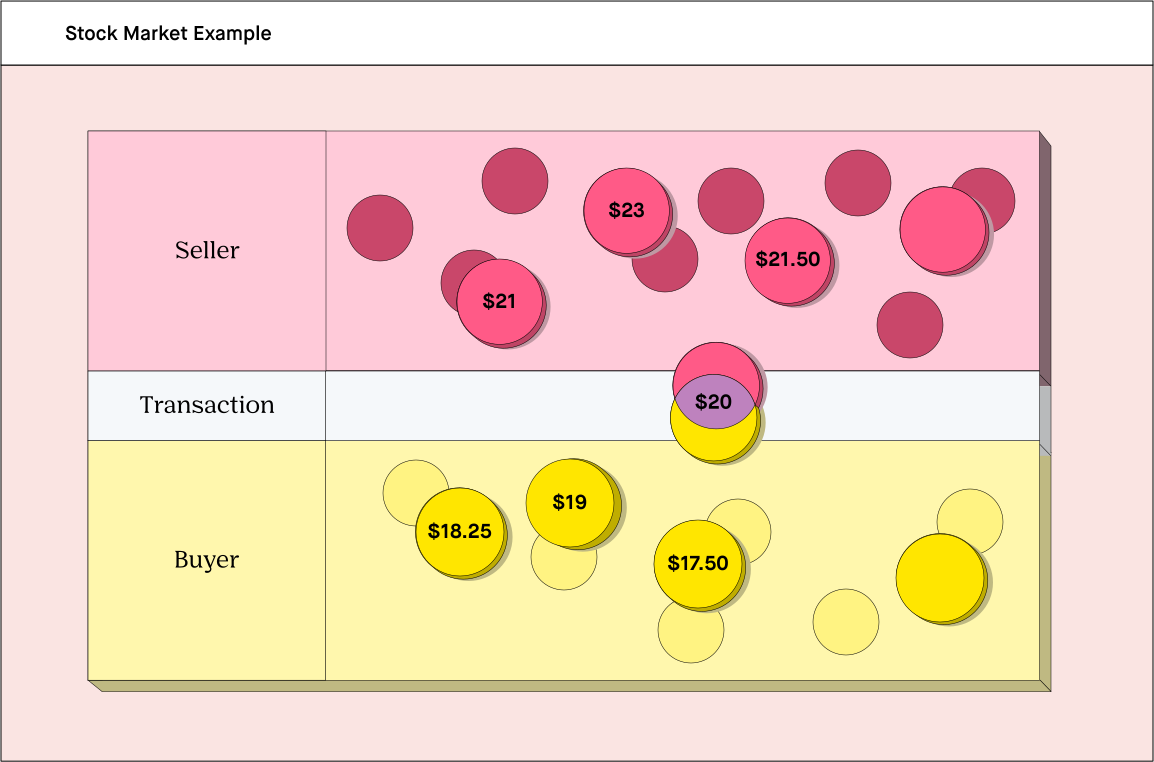
The actual execution of a trade price will be somewhere at or between the bid and the ask.
NOTE
Trades can be placed by stockbrokers, usually on behalf of portfolio managers or individual investors like you.
The primary role of the stock market is to bring buyers and sellers together to negotiate the trade of stocks. To determine the price, a stock market operates kind of like an auction.
- Buyers want to pay the lowest price possible. Stockbrokers who want to buy (or who represent customers who want to buy) can bid a price they’re willing to pay for a stock. The highest price becomes the “Best Bid.”
- Sellers want to sell at the highest price. Owners of stock or their stockbrokers can show their willingness to sell by placing an ask, which is the price they’re willing to sell a stock for. The lowest price becomes the “Best Ask.”
The difference between the Best Bid and Best Ask is called the “Spread.” The two sides negotiate to meet in the middle, and the intermediary who executes the trade takes the difference as their fee.
As you follow a stock, you’ll notice the share price moves. The share price can change frequently based on the number of investors looking to buy or sell the stock and the number of trades that happen.
Here are some of the key players you should know about:
- Retail investors like you can buy or sell individual stocks through your brokerage account. When you place an order, it’s sent to exchanges where the trades are executed.
- Stockbrokers are “registered representatives” who have gone through training and passed a licensing exam. They can buy and sell securities on behalf of investors. Stockbrokers work for brokerages, which can act as principals or agents in transactions, making money through markups/markdowns (as principals) or commissions (as agents) on trades. Many brokerages charge fees to their customers who use the brokerage to place orders and execute the trade of a stock.
- Portfolio managers act like restaurant owners — they’ll order a ton of food because they’re feeding plenty of people. Portfolio managers make large orders to buy and sell stocks because they manage relatively large stock portfolios, which can be owned by other investors like you. If you own shares in a fund (a mutual fund, retirement fund, pension fund, etc) a portfolio manager likely handles the bundle of underlying securities (stocks, bonds etc.) in the fund’s portfolio.
- Investment bankers help companies list shares on stock exchanges.
SEC
Stock markets handle trillions of dollars in wealth, so Congress has granted the authority to regulate stock markets to the US Securities and Exchange Commission (SEC).
The SEC sets rules and requirements that affect everyone participating in stock trading. While these rules can differ in specifics for different stock markets in different countries, they’re intended to protect the investing public through transparency, consistency, and accuracy.
- Price transparency: Stock markets should ensure that the best “bid” (the price a buyer wants to pay) and the best “ask” (the price at which a seller wants to sell) are displayed to participants to maintain fairness.
- Confirmations: If you’re a brokerage customer trading shares on the stock market, you’re entitled to a trade confirmation showing the key details of the trade. These can include the time the trade was made, the final price you paid, and (if your broker charges a fee) the specific commission or markup/markdown you were charged.
All about stocks
- Free/public float: Stock that has been released to the market and is traded publicly through an exchange.
- Stock splits: If a company wishes to make its stock price more accessible to investors, it will conduct a stock split. This will not change the market capitalization of the company — or the overall value of the shares you own — but it will increase the number of shares available.
- Stockholders equity: In its most basic form, it is the assets that remain in a company after covering all the bills (liabilities). This metric can be used to get a better understanding of the value of the stock.
- Short selling: When an investor wishes to speculate on a fall in the stock price, they can “short” a position. This requires borrowing the stock from either a broker or a financial institution. If the price drops, you can buy the stock at the lower price and make a profit. If the price of the stock rises and you buy it back later at the higher price, you will incur a loss.
- Broker: A broker will execute trades on behalf of an investor/trader and typically receives a commission in return.
- Market/limit/stop orders: When opening a trade, an investor needs to choose between a range of order types. A market order is executed at the next available price and can be risky if the stock price has a wide spread (the difference between the buyers and sellers are offering). A limit order is an order to buy or sell a security at or better than a specified price – this can mean that the order may not always get filled, particularly if the market moves quickly. Stop orders allow investors to set a trigger price in the system, which will only execute in the event the price hits the desired level. When this stop price is reached, the order automatically turn into a market order.
Dividends
A dividend is a cash payment made by a company to its shareholders out of its profits, as a reward for investors holding stocks.
dividend stocks are shares of stable, profitable companies that choose to pay a portion of their profits back to shareholders in the form of cash payments, rather than reinvesting all of that money into their business
- Dividends: These are the actual cash payments generated by the stock
- Dividend Yields: This metric allows investors to evaluate the return on their investment by dividing the annual dividend payment by the current stock price

As the share price keeps going up while the dividend stays constant, then dividend yield drops, which is generally true year to year.
If a stock has a dividend yield of 4% and priced at 4 dividend per share per year.
NOTE
Avoid dividend traps, which is investing in stocks with a 5%+ dividend yield, because that means they're just focused on attracting more shareholders rather than investing the profits back into R&D for the company, meaning that the company's growth will likely stall if they have a high dividend yield.
Investment accounts
There are two types of investment accounts:
- tax-sheltered accounts: lets you money grow tax free or have tax deductions, benefits for retirement.
- traditional IRAs: invest before tax, those investments become tax deductions, pay tax later after you take it out.
- roth IRAs: invest after-tax money, let it grow tax free and withdraw tax free.
- HSA: triple tax advantage, but you can only spend on healthcare related stuff.
- taxable brokerage account: stuff like Vanguard or Fidelity where you pay taxes on investment income and realized gains, as opposed to tax-sheltered accounts like an IRA or Roth IRA which offer specific tax advantages
| Account Type | 2026 Annual Contribution Limit | Upfront Tax Break? | Tax-Free Growth? | Tax-Free Withdrawals? | Early Withdrawal Penalty (Before 59½) |
|---|---|---|---|---|---|
| Pre-Tax 401(k) / 403(b) | 72,000 (total with employer) | Yes (Reduces current income) | Yes | No (Taxed as ordinary income) | 10% penalty + ordinary income tax |
| Roth 401(k) / 403(b) | $24,500 (shared with pre-tax) | No (Paid upfront) | Yes | Yes | 10% penalty + tax on earnings only |
| Traditional IRA | $7,500 (shared with Roth) | Conditional (Phaseout >$81k AGI if covered by workplace plan) | Yes | No (Taxed as ordinary income) | 10% penalty + ordinary income tax |
| Roth IRA | $7,500 (shared with Trad) | No (Direct limit phaseout 165k; bypassed via Backdoor Roth) | Yes | Yes | 0% penalty on principal contributions; 10% penalty + tax on earnings |
| Health Savings Account (HSA) | 8,750 (Family) | Yes (FICA + Federal + State tax exempt via payroll) | Yes | Yes (For qualified medical expenses) | 20% penalty + ordinary income tax for non-medical (after 65: 0% penalty, taxed like 401k) |
| Taxable Brokerage | Unlimited | No | No (Annual tax on dividends & realized gains) | No (Capital gains tax when sold) | None (100% liquid anytime) |
The main difference between after-tax Roth IRA and a normal brokerage account is in two places:
- capital gains:
- brokerage: in a brokerage account, you have to pay a 15% capital gains tax on the interest earned from each stock you sell
- roth: No capital gains, tax-free withdrawal in retirment
- pretax: No capital gains, but pay tax in income tax bracket when wirthdrawing in retirement.

Tax-sheltered accounts
Both Pre-Tax (Traditional) and Post-Tax (Roth) retirement accounts enjoy tax-sheltered growth while invested—meaning you pay $0 in capital gains, dividend, or interest taxes year over year in both account types.
The fundamental difference between them is not how fast they grow, but when you pay income tax: upfront today (Roth) versus upon withdrawal in retirement (Pre-Tax).
- when to use pre-tax: When your current tax bracket is significantly higher than your expected tax bracket in retirement, Pre-Tax contributions yield higher net gains and overall wealth.
- when to use post-tax: when you have a high income after 65, then you want tax-free withdrawals.
Pre-tax (Traditional)
How much tax you pay on the withdrawals from a pre-tax retirement account is dependent on your current tax bracket when you withdraw the money.
For example, if when you retire and have no income, you are in the 10% tax bracket, thus you have to pay a 10% fee on whatever you withdraw from your account.
Withdrawing from tax-sheltered accounts before 59.5 years of age results in a 10% penalty on whatever you withdraw, on top of income tax if not in a Roth account.
- example: if you're 20 years old, in a 22% federal tax bracket, an early withdrawal of 10K from a pre-tax retirement account will cost you $3200, resulting from the 10% early penalty fee and the 22% tax bracket combining to be a 32% tax on your withdrawal.
Post-tax (Roth)
The Roth IRA contribution limit in 2026 is 168K/yr.
However, if you want to contribute to a Roth IRA, you can instead open up a traditional Roth account, contribute to it, and then convert it into a normal Roth IRA via a Backdoor Roth account.
A backdoor Roth IRA is a financial strategy used by high-income earners who exceed the IRS income limits for making direct contributions to a Roth IRA.
Here's how it works:
- Nondeductible Contribution: Since you earn too much to contribute directly, you first contribute after-tax money to a traditional IRA.
- Conversion: Once the funds are in the traditional IRA, you convert them into a Roth IRA.
Because the contribution to the traditional IRA is made with after-tax dollars (nondeductible), you effectively bypass the income restrictions that normally prevent high earners from utilizing a Roth IRA.
Taxable brokerage account
When investing in a taxable brokerage account, you often pay taxes on the stocks you own:
- capital gains tax: when you sell a stock, you pay a tax on interest you earned from that stock, which is a tax on the profit made when you sell an asset (like a stock) for more than you paid for it, basically a tax on the gains you made on a stock.
- stock dividends tax: when you earn dividends from a stock, you get taxed on those earnings based on how long you've held that stock.
Capital gains get taxed based on how long you hold the investment.
- less than one year: if you hold a stock for less than one year before selling it, you will pay taxes on those gains equal to the tax rate of the tax bracket you're currently in
- more than one year: if you hold a stock for at least one year before selling it, you will pay a special reduced capital gains tax rate, which is like 15%
Stock dividends also get taxed based on how long you hold the investment:
- less than 60 days: if a stock paying dividends is held for less than 60 days, you will pay taxes on those dividends equal to the tax rate of the tax bracket you're currently in
- more than 60 days: if a stock paying dividends is held for more than 60 days, you will pay a special reduced dividend tax rate
Therefore, to reduce both dividends tax and capital gains tax, you must hold the stocks for longer, since holding stocks for longer than a year can qualify you for lower, long-term capital gains tax rates and dividends rates.
Tax efficiency
Tax efficiency refers to the specific tax advantages or benefits available for each type of investment that can help you pay less tax.
- dividend paying stocks: invest in these stocks only within a ROTH IRA tax-free account, because otherwise you'll have to pay capital gains tax on the dividends you earn if investing into a brokerage account.
- max out tax-sheltered accounts: each year, max out 401K, Roth IRA, and HSA
- Tax-loss harvesting: In taxable brokerage accounts, you can sell investments that are currently at a loss to offset any realized capital gains. You can then immediately repurchase a similar asset to maintain your original market exposure.
ETFs vs mutual funds
- Mutual Fund: This is described as a pool of investors who share both the risk and the reward by collectively buying a diverse range of companies and assets
- Exchange Traded Fund (ETF): Similar to a mutual fund, an ETF holds a basket of underlying assets—such as stocks, bonds, or cryptocurrencies—but it is designed to be traded on a stock exchange, making it highly liquid and easily managed
There are differences between the two:
- Costs and Access: ETFs generally have lower costs and no minimum investment requirements, whereas many mutual funds may have minimum investment amounts
- Variety and Management: Mutual funds often offer a wider variety of specialized or actively managed options, which is sometimes required for certain retirement accounts like 401ks
Why ETFs rule
ETFs are better than single stocks
Never try to pick single stocks. Warren Buffet and research has shown again and again that trying to beat the market by picking individual stocks and predicting which of them will do well is an impossible task.
NOTE
ETFs and SP500 have always consistently outperformed the market in the long-term
Warren buffet's advice is as follows:
buy a low-cost S&P 500 index fund and keep investing in it through thick and thin and eventually you'll become a millionaire
NOTE
The reason why the S&P 500 works so well is that it's a very reasonable bet to think that the 500 biggest companies in America will continue to do well and continue to grow on average throughout the years to come
The S&P 500 grows at an average of 7% to 9% each year. This return rate is pretty solid, because the absolute best return rate possible is 20% per year which only a few hedge funds achieve.
NOTE
You should not expect to double or triple your money. That never happens in the stock market.
In summary, here is why the SP500 is so good:
- you won't lose that much money: save for market crashes, you can expect 7-9% consistent annual returns because large companies continue to grow.
- the market will never completely crash: the only chance all 500 companies lose substantial value is in an apocalypse. That will never happen.
- it's a self-healing fund: the SP500 kicks out companies that fall below the market cap of the top 500 companies, meaning that only companies that are doing well will stay in the SP500 and you won't lose your money on any failing company.
Why you shouldn't try to pick single stocks
Your insight is never as good as you think.
To get a winning single stock, not only do you have to know which company will do well and which company will not go bankrupt, but you also have to predict the stock's growth graph over many years to come (because you don't want to be stuck selling early and you don't want to be stuck selling too late)
For example, how would you know which point to hold on and which point to sell? It's impossible to predict.

Unless you get really lucky, you will not beat the market and you'll perform lower than SP500.
-
Unsystematic / Concentration Risk: Individual tech stocks and sector funds carry single-company and single-industry risk. Single tech companies can experience 50–70% drawdowns or structural shifts over 10-year horizons.
-
Massive Overlap: Broad market funds like VOO or VTI already hold Nvidia (~6-7%) and Google (~3-4%) as top holdings. Adding direct NVDA, GOOGL, and FSELX (Fidelity Select Semiconductors, which has ~25% in Nvidia alone) creates massive triple-dipping in tech/semiconductors. You end up with 20%+ of your total wealth in a single sector.
The harsh truth is, I can’t pick winning individual stocks and you can’t either. Nor can the vast majority who claim they can. It is extraordinarily difficult, expensive and a fool’s errand. Having the humility to accept this will do wonders for your ability to accumulate wealth.
Even though research shows that most people are not good stock pickers, for some reason we always consider ourselves to be the exception. This is due to the disposition effect trap cognitive bias, which arises from regret avoidance and loss aversion, which leads to these two effects:
- Most investors sell winning stocks too early
- Most investors hold losing stocks for way too long.
[! ] statistically 90-95% of day traders lose money in the long run. This should be eye-opening.
- Never try to pick individual stocks.
- Don't be overconfident
Never buy high and sell low
For the SP500, after a market crash you can always expect the market to rebound. This is because the 500 biggest companies sustain the world, and if they crash, you know something apocalyptic is happening.
So don't realize the loss by buying high and selling low.

NOTE
Key insight: You will always make more money if you just hold on to your savings. To get compounding to work, never sell. Keep your shares and stick with them through thick and thin.
Don't try to outsmart the market thinking to sell on one day and then rebuy the next. You'll end up missing the best days in the market, resulting in losses.
Unfortunately, too many people take this at face value and leap to the conclusion that Mr. Buffett has found a magical way to dance in and out of the market, avoiding the inevitable drops. This is not true and in fact he is on record speaking to the folly of trying: “The Dow started the last century at 66 and ended at 11,400. How could you lose money during a period like that? A lot of people did because they tried to dance in and out.”

TIP
The best days of the market paradoxically happen more often during a market crash, so never sell in a panic.
NOTE
The market always goes up and it is always a wild and rocky ride along the way. Since we can’t predict these swings, we need to toughen up mentally and ride them out.
Thus the actionable tips here are:
- During market turbulence, do nothing. The SP500 will grow again, and if you sell, then you'll lose out on the best days of the market.
- never panic sell: The stock market is a powerful wealth-building tool and you should be investing in it. But realize the market and the value of your shares will sometimes drop dramatically.
- This is absolutely normal and to be expected. When it happens, ignore the drops and buy more shares.
- This will be much, much harder than you think. People all around you will panic. The news media will be screaming Sell, Sell, Sell!
- ignore the drops in the market: Nobody can predict when these drops will happen, even though the media is filled with those who claim they can. They are delusional, trying to sell you something or both. Ignore them.
- It is simply not possible to time the market, regardless of all the heavily credentialed gurus on CNBC and the like who claim they can.
DO NOT TRY TO TIME THE MARKET
NOTE
Market timing is an un-winnable game over time.
The point is that to play this market timing game well even once, you need to be right twice: First you need to call the high. Then you need to call the low. And you must be able to do this repeatedly. The world is filled with sad investors who got the first right and then sat on the sidelines while the market recovered and marched right on past its old high.
Do not listen to gurus who say they know the timing of the market.
Nothing, and I mean nothing, would be more profitable than this ability. That’s what makes it so seductive. That’s why gurus constantly claim they can do it, even if only a tiny bit. Nobody can. Not really. Not in any consistently useful way. Believing in Santa Claus is more profitable. Breeding unicorns is more likely.
NEVER EVER SELL
Trying to sell in a market crash is all about fear and greed, the two major emotions that drive investors. Fear is perfectly understandable. Nobody wants to lose money. But until you master it, such fear will be deadly to your wealth.
- The curse of fear is that it will drive you to panic and sell when you should be holding.
- The market is volatile. Crashes, pullbacks and corrections are all absolutely normal. They are all, each and every one, expected parts of the process.
Everybody makes money when the market is rising. But what determines whether it will make you wealthy or leave you bleeding on the side of the road is what you do during the times it is collapsing.
The market always goes up. Always. Bet no one’s told you that before. But it’s true. Understand this is not to say it is a smooth ride. It’s not. It is most often a wild and rocky road. But it always, and I mean always, goes up. Not every year. Not every month. Not every week and certainly not every day. But take a moment and look again at the chart of the stock market in the last chapter. The trend is relentlessly, through disaster after disaster, up.
The next 10, 20, 30, 40, 50 years will have just as many collapses, recessions and disasters as in the past. Like the good Professor says, it’s not possible to prevent them. Every time this happens your investments will take a hit. Every time it will be scary as hell. Every time all the smart guys will be screaming: Sell!! And every time only those few with enough nerve will stay the course and prosper.
This is why you have to toughen up, learn to ignore the noise and ride out the storm; adding still more money to your investments as you go.
You can expect the largest 500 companies to continue to grow. This is a safe bet.
Let’s take a moment to review why this is true. Stocks are not just little slips of traded paper. When you own stock you own a piece of a business. Many of these have extensive international operations, allowing you to participate in all the markets across the globe. These are companies filled with people working relentlessly to expand and serve their customer base. They are competing in an unforgiving environment that rewards those who can make it happen and discards those who can’t. It is this intense dynamic that makes stocks and the companies they represent the most powerful and successful investment class in history.
Investing tips
Tips and philosophies
Tips
- avoid overconcentration: Overconcentration is when you have over 10% of your portfolio in a single stock.
- reason: we saw that single stocks are volatile and no company is too big to fail. Invest only in ETFs.
- rule: the rule of thumb is that no single stock should comprise of over 5-10% of your portfolio.
- never buy high sell low: The only way to lose money is to sell a stock for less than what you bought it for. The absolute worst thing to do is when you buy a stock and then its price goes down, so out of fear you sell early before it can go back up, realizing those losses.
- diversify as much as possible: diversify your holdings across multiple different companies instead of betting your entire future on a single company.
- keep your funds in SP500: invest in SP500 and never sell until the end of your life.
- don't day trade: statistically 90-95% of day traders lose money in the long run. Never try to pick individual stocks. You'll just fail.
- never sell: buy an index fund and never sell. If you sell and miss the best days in the market, you're losing hundreds of thousands of dollars.
- save 50% of your income: this will let you retire early.
Philosophies
- 7% returns is actually good: You should not expect to double or triple your money. That never happens in the stock market.
- no company is too big to fail: That's why you should always diversify.
- stock picking is a sucker's game: you'll never be good enough to predict individual stocks ballooning.
- the market always goes up: it may not be a smooth ride, but over time the market always goes up.
- market crashes will always happen regardless. Stay the course: the market always rebounds after a market crash. Never sell. Keep investing.
- keep investments simple: Simple is good. Simple is easier. Simple is more profitable. Embrace simplicity
- past performance does not indicate future performance: do not stock pick based on historical performance of the stock. There is no way to predict how it will grow.
The simpler, the better
But the simple truth is this: the more complex an investment is, the less likely it is to be profitable. Index funds outperform actively managed funds in large part simply because actively managed funds require expensive active managers. Not only are they prone to making investing mistakes, their fees are a continual performance drag on the portfolio
Investing mistakes
Don't pick too many ETFs
Investing in too many ETFs on the SP500 is stupid because most of them are just overlapping.
TIP
Just pick a maximum of 3 ETFs.
Why people lose money on stock picking
There are these reasons why people lose money when they invest, and how to avoid those mistakes:
- they think they can time the market: We are psychologically unsuited to prosper in a volatile market because we are loss-averse and risk-averse. The reality is that we usually buy high and sell low, panicking when times are tough and buying when the market is soaring.
Here’s a sobering fact: The vast majority of investors in mutual funds actually manage to get worse returns from their funds than the funds themselves generate and report. Let that little nugget sink in for a moment. How can this be? Our psychology is such that we can’t help trying to “time” the market. We tend to jump in and out, almost always at the wrong times.
- we think we can pick stocks: You can’t pick winning stocks. Nor can the overwhelming majority of professionals in the business.
Even slightly beating the index year after year is incredibly difficult. Only a handful of investors have been able to modestly beat it over time. Doing so makes them superstars. That’s why Warren Buffett, Michael Price and Peter Lynch are household names.
- We believe we can pick winning mutual fund managers: 7% of mutual funds fail per year. The fact is, few fund managers will beat the index over time. 82% failed to outperform the unmanaged index. But 100% of them charged their clients high fees to try.
Other academic studies suggest that when looking at longer time periods, even an outperformance rate of 18% is wildly optimistic. In the February 2010 issue of The Journal of Finance, Professors Laurant Barras, Olivier Scaillet and Russ Wermers presented their study of 2,076 actively managed U.S. stock funds over the 30 years from 1976 to 2006. Their conclusion? Only 0.6% showed any skill at besting the index or, as the researchers put it, the result was “...statistically indistinguishable from zero.” They are not alone. Brad Barber of UC Davis and Terrance Odean of UC Berkeley found that only about 1% of active traders outperform the market and that the more frequently they trade, the worse they do.
There’s lots of money to be made with actively managed funds. Just not by the investors.
- we believe day trading works: day trading is gambling, like the foam that is not the actual value behind a business. This is the market that, if you are smart and want to build wealth over time, you will absolutely ignore.
When you look at the daily price of a given stock, it is very hard to know how much is foam. This is why a company can plummet in value one day, and soar the next. This is why CNBC routinely features experts, each impressively credentialed, confidently predicting where the market is going next—while consistently contradicting each other. It is all those traders competing to guess how much beer and how much foam is actually in the glass at any particular moment. While this makes for great drama and television, for our purposes it is only the beer that matters. It is the beer that is the real operating money making underlying businesses, beneath all that foam and froth, that over time drives the market ever higher.
- we are overconfident: Most people confident in their stock picking abilities actually underperform the market.
how to choose individual stocks
Look at these 5 indicators to decide whether investing in an individual stock is worth it:
- revenue: how much revenue is the stock making?
- net income: how much profit is the company making?
- price to earnings ratio: what is the P/E ratio of the stock, meaning how much are the investors willing to pay for $1 of the company's earnings?
- high P/E reflects optimism about company's growth, but it can also represent overevaluation
- low P/E reflects slower growth potential or undervaluation of a company

Stocks that pay dividends
You want to invest in stocks that pay dividends further down the line.
-
Total Return vs. Dividend Yield: During your accumulation phase (Age 22–32), your goal is maximizing overall portfolio growth (Total Return = Capital Appreciation + Dividends). Dividend-focused funds (like SCHD/VYM) deliberately filter for mature, cash-distributing companies (banks, utilities, consumer staples) and exclude high-growth companies that reinvest earnings into expansion.
-
Dividend Irrelevance: When a company pays a dividend of 1 on the ex-dividend date. Dividends are not bonus returns; they are forced liquidations of company equity.
-
Tax Efficiency in Taxable Accounts: If held in a taxable account, dividends trigger annual taxes (qualified dividend tax rates up to 15%–20%), creating tax drag. Dividend funds are better suited during the decumulation (spending) phase if income generation is needed, not during the rapid wealth-building phase.
So these are the stocks that pay dividends:
- JPMorgan: has a 3.5% dividend yield
- Exxon
- Heinz: has a 4.62% dividend yield
- Home depot: has a 2.7% yield, and is very profitable and grows in a bullish market and has a monopoly on the housing sector.
- VOO: VOO pays a 1.75% dividend yield
What to invest in based on market cap
Based on market cap, you have these categories:
- micro cap: companies valued at less than $300M in the stock market
- Investing in micro cap companies is high risk high reward, since they're considered as penny stocks.
- small cap: companies valued from 2B in the stock market
- large cap: companies valued over $10B
- Investing in large cap companies is low risk low reward, because you will not see much growth from larger companies.
Which ETFs to invest in
The best ETFs to invest in have these criteria:
- expense fee < 0.1%: you want to invest in ETFs with a low expense fee rate
- no load fee
ETFs
- VOO (Vanguard S&P 500 ETF): very good, first choice, 0.03% expense fee and has 1.78% dividend yield.
- VTSAX: Vanguard Morningstar Total Stock Market Index Fund Admiral Shares
- FXAIX
- FZROX
- VTI (vanguard total stock market ETF)
- VEU (vanguard global etf excluding US): good for international ETFs
- Vanguard FTSE global index fund: index fund of top 3700 companies across the world.
ETF Stocks that pay dividends
Only do these in tax-retired accounts so you don't pay capital gains tax on dividends.
- Vanguard High Dividend Yield ETF
- Schwab US Dividend Equity ETF
- VOO: very good, also has 1.75% dividend yields
ETF fees
ETFs have a percentage fee per year which they take from all your investment money in that fund, ranging from 0.03% - 1% of your holdings.
Here's a common misconception:
"Choose high fee ETFs with a 1% fee, since they'll perform better and the fee won't be as damaging."
But in reality, a higher fee does not equal higher performance.
- evidence shows low-fee ETFs outperform high-fee ETFs: Decades of SPIVA (S&P Indices Versus Active) data show that over a 10-year period, 85% to 90%+ of active funds charging 0.50%–1.00%+ fees underperform low-cost index funds (like VOO/VTI at 0.03%).
- High fees actively erode compounding wealth from day one. On a 1,000 every single year just in management fees, regardless of whether the fund goes up or down. Over a 10-year FIRE horizon, that fee drag compounded destroys tens of thousands of dollars in gains.
Investment strategy
Tax-Advantaged Accounts (403b, Roth IRA, HSA)
-
Primary Objective: Maximize total return and growth without tax drag.
-
Core Core Holdings: Total US Stock Market / S&P 500 + International Stock Market.
-
Option A (Fidelity Zero Funds): FZROX (Fidelity ZERO Large Cap / Total Market, 0.00% ER) + FZILX (Fidelity ZERO International, 0.00% ER).
-
Option B (Vanguard ETFs inside Fidelity): VOO (0.03% ER) or VTI (0.03% ER) + VXUS (0.08% ER).
-
Taxable Brokerage Account
-
Primary Objective: Build the early retirement bridge fund (Age 32 to 59.5) with maximum tax efficiency.
-
Holdings: Low-turnover, low-dividend, tax-efficient ETFs.
-
VTI (Total US Stock Market ETF, 0.03% ER) or VOO (S&P 500 ETF, 0.03% ER) — 80% to 90%
-
VXUS (Total International Stock ETF, 0.08% ER) — 10% to 20%
-
Individual Stock / Sector Tilt (Optional): Capped at max 5% total if desired (e.g., NVDA/GOOGL/FSELX).
-
The wealth accumulation strategy
In the wealth accumulation strategy, invest everything in VTSAX and let it sit there forever.
Investment platforms
Trading 212
Budgeting
Creating a budget
A budget is always created with after-tax income you have on hand, so this terminology is important:
- Gross income is your total pay, before taxes and deductions. This includes the wages you earn, the money you make from your side hustles, and even income from some savings or investment accounts.
- Net income is what you get to take home, after taxes. When budgeting, it’s helpful to consider your net income because that’s the money you can actually use.
- fixed costs are things you must pay for, often on a monthly basis
- variable costs are things you want, which aren’t 100% essential
There are three types of budgets:
- 50/30/20 rule: 50% for needs, 30% for wants, 20% for savings
- 30% housing rule: only take on rent that is max 30% of your budget
50/30/20 rule
A budget should be separated into three categories:
- needs: rent, utilities, groceries, insurance, etc.
- wants: entertainment, gym, dining out, short term goals, etc.
- savings: emergency fund, investment
The best proportion for a monthly budget is the 50-30-20 rule, where you divvy up your monthly after-tax income to go to these weighted categories:
- 50% needs
- 30% wants
- 20% savings
For 8000/month after-tax income, here is how you can spend it in a budget:
- 50% needs: $4000 for rent, utilities, groceries
- 30% wants: $2400 for dining out, subscriptions, entertainment
- 20% savings: $1600 to put into Roth IRA or investment brokerage
What to track
There are three important numbers to track:
- Savings / savings rate
- Expenses
- Net worth
If you are able to track these three numbers over time, your financial position will improve year by year.
TIP
You cannot improve what you don't track. So track your expenses
Tracking expenses
Your expenses should be categorized as follows:
- fixed or variable: fixed expenses are constant from month to month, like subscriptions or rent, while variable expenses vary, like groceries or eating out.
- necessity or discretionary: do you need this expense or not?
Rules of budgeting
- Track every expense you have
- Save up enough money in your bank account for an emergency fund worth 3-6 months of income.
- For short-term goals of stuff you want to buy, always create SMART goals and then set up automated savings for those goals.
- Have a savings first mindset. Set up automated investing and savings
- Follow the [[#1% rule]] to avoid making large impulsive purchases.
Now here are the actionable tips:
- Create an app or excel file to track all your spending
- Save up 20K in your bank account for an emergency fund
- Create an automation to invest at least 15-20% of your income into investment accounts.
Emergency fund
Save up enough money in your bank account for an emergency fund worth 3-6 months of income.
This is typically
Financial Goals
To create short-term budgeting goals for things that you want to save for or buy, you should create SMART goals following this format:
- specific: a specific thing you want to buy or save for
- example: a new macbook pro
- measurable: has a numerical monetary value attached to it
- example: a new macbook pro that costs 3.6K
- achievable: achievable within the timeframe you set for yourself
- example: completely achievable to save for a 1000/month
- realistic: you can realistically and practically achieve it now, it doesn't rely on ideals or something you don't have yet.
- example: completely realistic to save for a 1000/month and you earn $5000/month after tax.
- time-bound: put a timeframe on it.
Here are the rules for short-term goals:
- convert expensive wants to short-term goals: You should create SMART short term goals from expensive wants in your budget or financial goals you want to reach. use the 1% rule to classify whether a "want" should be transferred into a short-term goal rather than an impulsive purchase.
- short-term goals are achievable in less than 3 years: A short-term financial goal is something you can achieve in less than 3 years.
- short-term goals should have liquid savings: to save for a short-term goal, you must save into liquid assets like checking accounts.
Then to achieve those short term goals, do the following:
- calculate the amount you need to save per month to achieve that goal by the due date
- Automate those savings into a liquid account (not stocks)
Here are example of SMART short term goals:
- I want to buy a $3600 macbook pro in the next three months
WOOP Method
People using the WOOP goals method spend way more time working on their goals compared to regular goal setting.
WOOP uses mental contrasting to visualize the desired outcome and all possible obstacles in the way of that outcome, then plan how to overcome those barriers.
- Wish: ask yourself, "what is your wish that is challenging, yet feels achievable?"
- Answer it in a systems-thinking, like "I want to go to the gym everyday for 1 hour"
- Outcome: picture yourself experiencing the desired outcome
- The outcome of going to the gym for 1 hour every day is a ripped body at the end with a 6 pack.
- Obstacle: think about potential obstacles you might face on your way to the outcome and write them down.
- Plan: plan to overcome obstacles with this syntax: "If
obstacleoccurs, then I willactionto overcome it."
Thinking about the obstacles provides these three benefits:
- It gives you energy to tackle challenges
- It helps you find creative solutions
- It gets your brain working on solutions automatically
Automate savings
The best way to achieve your financial goals is to automate savings towards them.
In summary
The 4 best tips to achieve your goals are as follows:
- Use the WOOP method
- Set up automated savings
- Write down your goals and break them down into subgoals. People who write down their goals are more likely to achieve them.
- put your goals somewhere visible: having your goals somewhere on a sticky note will make it more likely to achieve them.
Avoiding lifestyle creep and overspending
You could have 500K income but still live paycheck to paycheck because of lifestyle creep.
NOTE
The true way to build wealth is by saving more than you spend.
To become rich, you need to keep your spending habits the same while trying to increase your income.
To practically implement avoiding overspending, use these techniques:
- 1% rule: Think twice before making a purchase that is above 1% of your net worth. Take a day to think about it before making the purchase.
- "wait for it rule": if you want to buy something above $50, make yourself wait for a week and then buy it if you really want to.
- something in, something out: if you want to buy something, then you must also prepare to donate something.
1% rule
Think twice before making a purchase that is above 1% of your net worth.
Path to wealth
Best wealth tips
- earn passive income: If you don’t make money while you sleep, you will work until the day you die.
- You will never become rich by renting out your time.
- live below your means: live below your means via these tips:
- have a savings-first mindset: always invest at least 15-20% of your income yearly.
- 1% rule: think twice before making a purchase that is above 1% of your net worth.
- budget: budget and track what you spend
- invest in an etf: It’s not about timing the market, it’s about time in the market.
- A simple index fund left alone for 10 years will outperform all hedge funds in the world
4 pillars of building wealth
- protect the gap: put aside salary each month towards savings, live below your means
- invest aggressively and consistently: start off by investing 15-20% of your income per year into ETFs
- time: take advantage of compound interest by never selling. Put your money into an ETF and forget about it.
- ensure no leakage: make sure to not pay high fees on the ETFs. Invest in a low-cost ETF for a long time.
Learn to live on less
Two close boyhood friends grow up and go their separate ways. One becomes a humble monk, the other a rich and powerful minister to the king. Years later they meet. As they catch up, the portly minister (in his fine robes) takes pity on the thin and shabby monk.
Seeking to help, he says: “You know, if you could learn to cater to the king, you wouldn’t have to live on rice and beans.”
To which the monk replies: “If you could learn to live on rice and beans, you wouldn’t have to cater to the king.”
Most all of us fall somewhere between the two. As for me, it is better to be closer to the monk.
" If your goal is to become financially secure, you'll likely attain it but if your goal is to make money to spend money on the good life, you're never going to make it."
Live below your means, and you'll become a millionaire.
Follow these rules which actually make the abstract concrete:
- **If you have less than 100K in your bank accounts, follow these rules
- no eating out: discount groceries only
- no designer clothes: goodwill only
- Don't fly first class unless you have $5M in net worth
Income matters more than cutting costs
Increasing income will always be your biggest lever towards wealth, not aggressively saving.
There are three ways to reliably increase income:
- job hop
- Learn a new skill
- Get education and certifications
The best investors are usually the most boring ones who just try to spend all their energy increasing their income and then investing it in ETFs.
That's you best path to wealth.
Compound interest is the 8th wonder of the world
Time compounding is the biggest factor in wealth increase.
Here's an example where even though Jasmine contributed twice as much as Miguel, Miguel has more money simply because he started earlier.

You can become rich at 65 even on an average salary of 62K even if you invest only 6K per year starting at 18:

NOTE
the simple path to wealth is to invest aggressively and consistently. This is because compound interest is the 8th wonder of the world.
Most of Warren Buffett's net worth came later on in his life, after 30 years of investing. Trust the compounding. Trust that it works. It happens at a later inflection point in life but after you hit the 100k mark in your investments, your portfolio rapidly begins to rise.

How to increase income
Asking for a raise
To successfully get a raise, prepare a pitch beforehand and schedule a time with your supervisor for the raise negotiation.
Here is what you should focus on in your pitch:
- Your recent accomplishments and victories
- Your skills
- Your pay relative to others on Glassdoor
- How the extra pay would help you contribute more to the company
- Let the boss know how valuable you are to the team.
Timing is also important here. You can increase the chances of getting an affirmative answer by:
- Formally scheduling time for the discussion
- Scheduling the appointment 10-12 weeks before your annual review
- Asking soon after a workplace victory
Freelancing
Here are the best sites for freelancing:
- Fiverr
- Upwork
- Catalant
- Expert360
Passive income ideas
- writing and publishing an EBOOK: publish to amazon and sell on gumroad and etsy, heavily market them.
Financial freedom via business
The millionaire fastlane - the new rich
the only way to become financially free in your 20s is to create a business. That is the absolute only way. No salary job will get you there.
principles of financial freedom
To achieve financial freedom by growing a business, keep in mind these principles and tips:
- keep going: creating a business and earning money from it takes time.
- Have impatience for actions, extreme patience for results.
- action as a foundation, learning as a supplement: becoming financially free from a business requires a strong bias to action and then you learn to supplement that action.
- Go first for project-based learning, where you create a business and then you learn as needed on the side.
- find a way to make the journey fun: find a way to make the journey to financial freedom fun and you can do that by living authentically and loving what you do
- choose discipline over regret: In life, we have to choose between the pain of discipline or the pain of regret. Discipline weighs ounces while regret weighs tons.
FIRE
FIRE is a movement to retire early by saving as much money as possible and then investing all of it in low-cost ETFs and then living off 4% of your yearly returns of your stock portfolio.
Rules
The 4% rule tells you when it's okay to retire, when you can live off 4% of your yearly returns of your stock portfolio. It's basically that number where you can then start to retire because now you can live off your returns, accounting for inflation.
- example: if you spend 1M invested.
NOTE
This comes from actual research: retirees can always withdraw 4% from their portfolio yearly even through the worst stretches the market has ever seen.

In summary, here are the rules all FIRE methods follow:
- Invest in low-cost ETFs
- Max out Roth IRA
- Max out traditional 401K
investment for FIRE
To retire at age 32 while retaining liquidity before age 59½, save 80K-90K per year and then build a three-bucket portfolio:
- pre-tax 403B/401K: invest $24.5K/yr pre-tax, save extra 7.1K and invest that.
- roth IRA: invest $7.5K/yr after-tax
- taxable brokerage accounts: Save 48.3K/yr
Strategy 1
Here's a good strategy
- tax-advantaged (403b, roth IRA, HSA):
- 80% US stock: VOO or FZROX
- 20% international stock: FZILX or VXUS
- tax-brokered
- 80% US SP500 ETF: VTI or VOO
- 15% internation stock: VXUS
- 5% individual stock: NVIDIA, GOOGLE, FSELX
NOTE
Why VTI / VOO in Taxable? Broad market index ETFs generate low turnover and minimal capital gains distributions, allowing your money to compound untaxed until you sell shares in early retirement.
In summary:
-
Consolidate Taxable Investing at Fidelity (4,900 / month)
-
Open a single Individual Taxable Brokerage account at Fidelity alongside your existing 403(b), HSA, and Roth IRA.
-
Concrete Next Step: Log into Fidelity, navigate to "Open an Account," select "Individual Brokerage," and link your primary checking account for direct transfers.
-
-
Establish Core Index Fund Allocations ($80,000 / year total)
-
Allocate $24,500/year to your pre-tax 403(b) in broad U.S. index funds (e.g., Fidelity S&P 500 / Total Market Index).
-
Allocate $7,500/year to your Backdoor Roth IRA in zero-cost index funds (e.g., FZROX / FZILX).
-
Allocate the remaining ~59,200/year in your Fidelity Taxable Brokerage using 80% VTI (or VOO), 15% VXUS, and 5% maximum in individual stocks/sector tilts.
-
Concrete Next Step: Set up automated monthly transfers from your checking account into your Fidelity taxable account occurring 2 days after each paycheck.
-
-
Cap Single-Stock / Sector Exposure (Max 5% of Total Portfolio)
-
Limit combined holdings in individual stocks (Nvidia, Google) or sector funds (FSELX) to no more than 5% of your total net worth (~80,000 investment) to protect your baseline FIRE trajectory.
-
Concrete Next Step: Set an annual portfolio review reminder every December to rebalance individual stock holdings back to your 5% cap if outsized growth pushes them above that threshold.
-
strategy 2
Here's the recommended action plan
-
**Elect 100% Pre-Tax for your 403(b) (2,041.67 per month in traditional pre-tax contributions to capture $7,174.75 in annual tax savings.
- Concrete next step: Log into your employer's HR portal today and set your 403(b) deferral election to Pre-Tax.
- stocks to choose:
- 20% FZROX (Fidelity ZERO Large Cap / Total Market, 0.00% ER)
- 20% FZILX (Fidelity ZERO International, 0.00% ER)
- 60% VOO
-
**Fund a Backdoor Roth IRA (625 per month (or $7,500 lump sum) into a Traditional IRA and execute an immediate Roth IRA conversion to build a tax-free principal bucket.
- Concrete next step: Open a Traditional and Roth IRA with a brokerage (e.g., Vanguard, Fidelity, Schwab) and complete your $7,500 annual contribution before the tax filing deadline.
- stocks to choose:
- 20% FZROX (Fidelity ZERO Large Cap / Total Market, 0.00% ER)
- 10% Schwab US Dividend Equity ETF
- 10% Vanguard High Dividend Yield ETF
- 60% VOO
-
Automate remaining funds into a Taxable Brokerage Account (4,900/month): Invest your remaining take-home cash (~59,200/year) into low-cost, broad-market index funds to build your bridge fund for early retirement living expenses.
- Concrete next step: Set up an automated recurring bank transfer on payday to purchase broad-market index funds within 3 business days of receiving each paycheck.
- stocks to choose:
- 45% Vanguard S&P 500 ETF (VOO)
- 45% SPDR S&P 500 ETF Trust (SPY)
- 5% nancy pelosi tracker
- 5% NVDA/GOOGL/FSELX
401K strategy
If you're earning a high amount of salary now and you want to save as much as possible, you should go completely for pre-tax traditional 401(k) contributions so that you get more tax deductions and are able to invest that money into a taxable brokerage account.
pre-tax contributions here will lead to more money overall because once you retire you're not going to have any more income. Pre-tax is better if your expected income in retirement is much lower than your current income, which leads to a lower tax bracket in retirement.
-
Current Salary: $145,000 in Virginia
-
Top Marginal Tax Bracket: 24% Federal + 5.75% Virginia = 29.75% combined marginal tax rate
-
Pre-Tax 403(b) Max Contribution: $24,500
-
Immediate Cash Tax Savings: **24,500 block)
By choosing Pre-Tax for your 403(b), you keep an extra **7,174.75 into a Backdoor Roth IRA or Taxable Brokerage account, increasing your total invested capital pool.
When you retire at age 32 living on $40,000 per year:
-
Federal Standard Deduction: ~$16,100 (taxed at 0%)
-
Remaining Taxable Income: ~$23,900 taxed in the lowest 10% and 12% brackets
-
Estimated Effective Tax Rate: ~10.5% total (Federal + Virginia), compared to the 29.28% you saved today.
Do this right fkn now
-
Max Pre-Tax 403(b) Contributions ($24,500/year)
-
Set your payroll deduction to 24,500 and save $7,174.75 in annual cash taxes.
-
Concrete Next Step: Log into your employer benefits portal and adjust your 403(b) deferral percentage to hit $24,500 by December 31.
-
-
Execute Annual Backdoor Roth IRA ($7,500/year)
-
Contribute $7,500 to a Traditional IRA and execute a non-deductible conversion into your Roth IRA to bypass income phaseout limits.
-
Concrete Next Step: Transfer $7,500 into your Fidelity Traditional IRA, wait for cash settlement, and execute the online "Convert to Roth" steps before the tax deadline.
-
-
Fully Fund HSA & Retain Medical Receipts ($4,400/year)
-
Direct $366.67/month via payroll deduction into an HSA to bypass FICA and income taxes, and invest the balance in low-cost index funds.
-
Concrete Next Step: Set up an HSA digital folder in cloud storage to upload electronic receipts for medical expenses incurred from this point forward.
-
-
Automate Bridge Funding in Taxable Brokerage (4,900/month)
-
Direct remaining post-tax income into low-cost, tax-efficient ETFs (80% VTI/VOO + 20% VXUS) inside a single Fidelity taxable account.
-
Concrete Next Step: Configure automatic recurring purchases inside Fidelity to buy broad-market ETFs on the 1st and 15th of every month.
-
Methods
Here are the different methods:
- traditional FIRE: invest 30-50% of your after-tax income yearly, retire at the 4% rule.
- timeline: Assuming $100K income after tax, this method will take you 13-15 years to retire.
- COAST FIRE: spend 7 years in the traditional FIRE path, and then stop contributing to your retirement account, let it compound. Take up a lower paying job that you like.
- timeline: Assuming $100K income after tax, this method will take you 7 years to retire.
- frugal FIRE: invest 90% of your after-tax income yearly, retire at the 4% rule.
- rules: to achieve this extreme savings, never eat out, don't have any streaming services, no unnecessary expenses, find a cheap place to live.
- ratio: live off 20-30% of your after-tax income, invest the rest
- timeline: Assuming $100K income after tax, this method will take you 9 years to retire.
- divided FIRE: go traditional FIRE but by investing only in stocks that pay dividends so you get passive income for the rest of your life so you don't need to withdraw from your retirement account.
- timeline: You would need $1.25M invested into dividend-paying stocks in order to get 50K/year in dividends, meaning with traditional FIRE you could retire in 20 years.
- slow FIRE: invest 15-20% of your income after taxes, retire at the 4% rule
- timeline: Assuming $100K income after tax, this method will take you 27 years to retire.
COAST FIRE
- Calculate your COAST FIRE number based on the income you have right now

- Calculate the timeline

In my example, earning 145K/yr, my COAST FIRE number is 2.9M, which means the following for the investment timeline:
- 40 years to go: if you invest 5% of your coast fire number, which is 145K, and then stop touching your retirement account, it will grow to 2.9M in 40 years and then you don't have to invest anymore.